
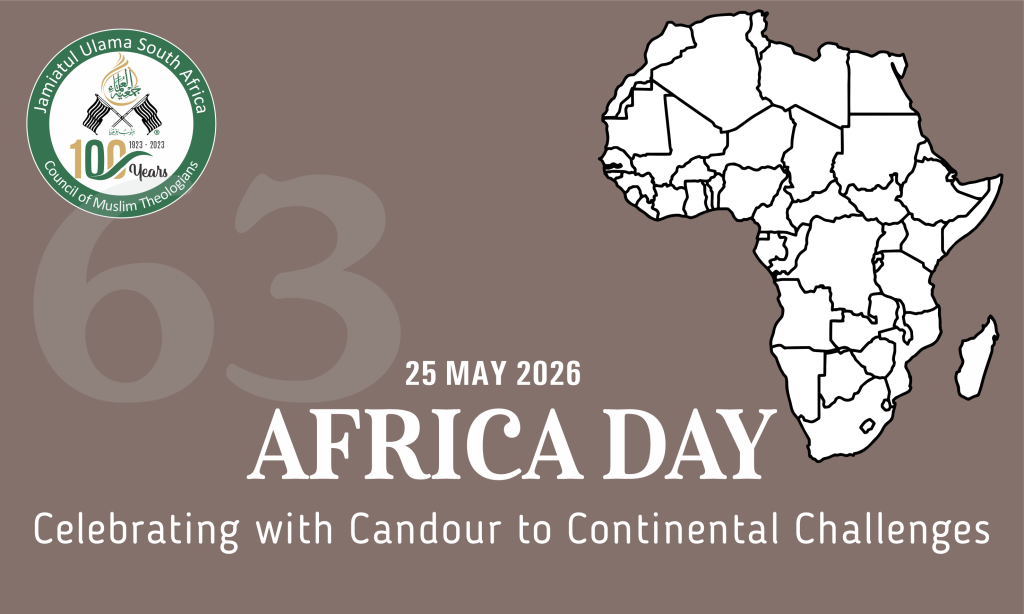
Africa Day: Awaken the Giant
A PRESS STATEMENT
The AU has themed this year’s commemoration of Africa Day: Sixty three (63) Years of Unity, Integration and Development, let’s celebrate together.
It is evident that Africa is resource-rich; not poor but poorly organised. It has half of the world’s uncultivated arable land and a third of its mineral wealth. Its abundance is also through an endowment of a population of 1.5 billion, mostly youth. The continent has everything needed to lead the world. Yet, resources continue to be extracted, continental sovereignty undermined, and potential squandered, both by outside forces and own political fragmentation and mal-administration.
On this Africa Day, the invitation to celebrate without candour would be mere performance. We cannot overlook that Africa is a sleeping giant, still struggling to develop to its true potential, amidst fragmentation, in spite of initiatives to integrate, from the time of the founding of the Organisation of African Unity (OAU), to the present-day African Union (AU).
To begin with, member nations have to end self-inflicted harm, jostling for bilateral favours from the very powers that once colonised them. There is strength in forging regional integration which should translate into a cohesive continental voice of the African Union, not just whispering when the moment demands decisive action, for both continental security and economic progress.
African unity as a moral project demands of us not to turn the other way when human rights of a besieged people are being trampled upon. South Africa’s exports of coal to Israel as an example of bilateral trade deals and defence contracts of African countries with the occupying powers, are quietly replacing that principled stance. Abstentions, albeit indicative votes regarding Palestine at the United Nations, do not betray only the Palestinians but also the vision of the OAU founding fathers and every freedom fighter who counts on world solidarity against injustice.
An integrated continent remains a dream as Afrophobia, time and time again, rears its ugly head, tearing the continent from within, with attacks on fellow Africans. The dearth of leadership and years of conflict and mismanagement, create push factors of refugees and economic migrants that are perceived to be responsible for taking opportunities of locals in the relatively more stable and prosperous host countries. Yet, it is necessary to note that the Congolese refugee, the Malawian labourer and the Somali trader are not the cause of South Africa’s inequality. For that we have to challenge the systemic factors that exploit, and concentrate wealth in the hands of few, while impoverishing the rest.
The spectre of another public health emergency in the form of an Ebola outbreak which has already claimed hundreds of lives, exposes the lack of health protocols, on a continent still dependent on foreign pharmaceutical supply chains. When Africa produces less than 1% of the vaccines it consumes, it is not merely a health failure but a sovereignty crisis.
Fresh perspectives will lead the continent to conclude that no African nation is large or wealthy enough to thrive alone. Genuine integration must be accelerated. Just as liberation was never a government project alone, civil society has to play roles by mobilising and harnessing the resources of activists, faith communities, trade unions and youth networks, who must build pan-African solidarity across borders.
With a median age of nineteen, Africa’s unity project must place the young people at the centre of development projects not merely as recipients of programmes but real decision-makers in matters affecting their future.
The recent announcement of the opening of an embassy of Somaliland in Jerusalem, against international consensus, reveals the fragmentation which benefits the occupiers. South Africa has shown the way of making Palestinian solidarity a foreign policy principle at the AU. The AU should lead a binding UN resolution linking Africa’s anti-colonial legacy to Palestinian dispossession. The same moral standard that once governed the world’s relationship with apartheid South Africa should apply.
Continental institutions such as the Africa CDC need to be adequately-resourced and sufficiently empowered to build continental health sovereignty. It must become a genuine authority with powers to coordinate cross-border responses and promote pharmaceutical production on African soil.
Many continental conflicts have morphed into proxy wars of external powers. African leaders must name foreign governments and corporations that fund continental strife, and give the AU’s Peace and Security Council real authority to hold both member states as well as non-statist actors accountable.
Leadership demands telling the hard truths to the African citizenry. Solidarity and genuine independence cost something. With such honesty and spirit, we can build a continent that looks at every suffering African, regardless of wherever they are, and says: we are together.
Released by:
The Executive Committee
Jamiatul Ulama South Africa
07 Dhu al Hijjah 1447 / 25 May 2026