
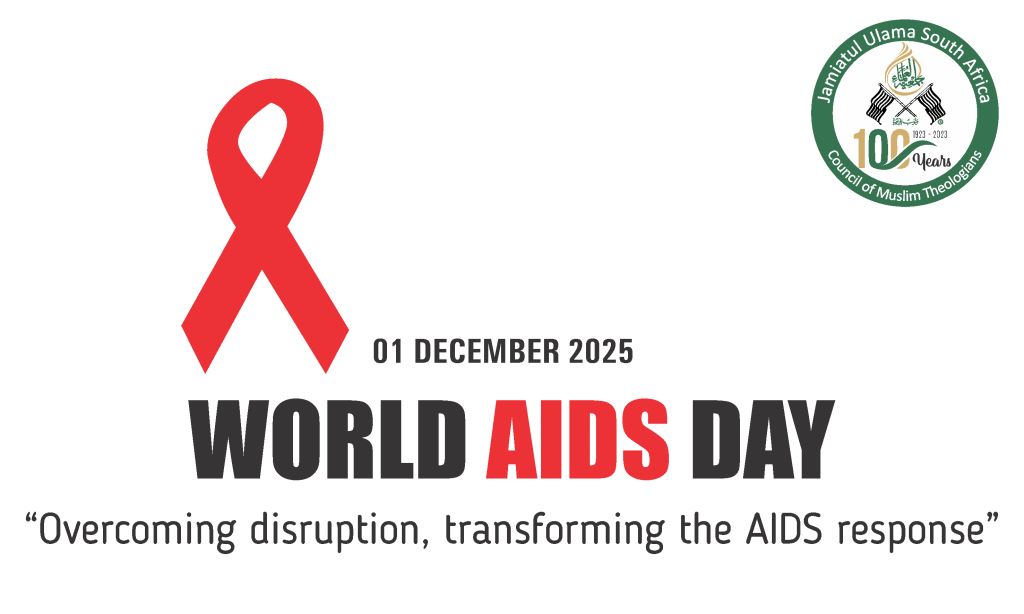
World AIDS Day | Prevention Remains Key in the Fight against HIV/AIDS
“O young men…, do not commit adultery, and guard your chastity. No doubt, whoever guards his chastity will certainly enter Paradise.” (Tabaranī)
A PRESS STATEMENT
As we mark World AIDS Day*, Jamiatul Ulama South Africa (JUSA) calls for careful management of resources, in order to meet the needs of the infected and affected. There have been concerns in the health sector that external funding cuts could lead to defaults in therapy, exposing the population to other public health risks which were slowly but steadily being brought under control.
This year’s World AIDS Day theme: “Overcoming disruption, transforming the AIDS response”, is apt in recognising, on one part, the critical nature of the sustenance of interventions to ending the pandemic. An abrupt termination of support under the incoming US administration starting from January 2025, led to clinic closures, personnel layoffs and service disruptions across the Global South.
According to the World Health Organization (WHO), in 2024, an estimated 40.8 million people were living with HIV globally. Approximately 630 000 people died from HIV‑related causes in the same year, while an estimated 1.3 million people became infected with the immunity-compromising virus.
For almost 45 years since the first official reports of what would later be identified as AIDS, at least 44 million people have died from AIDS-related conditions. The Sub-Saharan Africa region accounts for two-thirds of the current global case load, with 25.6 million people living with HIV in 2023. The HIV/AIDS prevalence rate of almost 13 percent in South Africa remains the highest in the world, causing much social dislocation, great strain on health-related services and general welfare.
A July 2025 media report shows that South Africa relied on PEPFAR— a United States AIDS emergency relief fund— for 17% of its HIV budget, supporting 5.5 million citizens on antiretrovirals (ARVs). The sudden halt in aid led to the termination of 40 projects, and causing an immediate drop in HIV testing capacity by 8.5%. Diagnoses fell by 31%, and treatment initiations slipped by 30% in affected Johannesburg areas.
This is a wakeup call in the fight against HIV/AIDS. Any backsliding almost certainly translates into serious long-term implications for national public health, and the country’s strategic position, given the pandemic’s impact on social stability, human resources and economic productivity. This is a moment which demands sustainable self-reliance in tackling key national challenges, in order to minimise exposure.
For an AIDS-free generation, prevention is ever important, especially among the youth. To this end, the central pillars of JUSA’s awareness campaigns have been abstinence and fidelity in relationships.
Besides providing nutrition to orphaned and vulnerable children, JUSA also collaborates with other agencies that provide shelter, offer counselling and mobilise for treatment compliance, among other interventions.
In line with this year’s second part of the theme, “transforming the AIDS response”, it is also important to fast-track the incorporation of new technologies in areas such as testing and tracing, in order to consolidate the gains, and accelerate the ending of the pandemic that is still claiming lives and causing much suffering. Ultimately, “Allah does not change the condition of a people until they change what is in themselves.” (Qur‘ān 13:11). May Allah grant our nation transformational rectitude, and the resolve to turn unto Him.
Released by:
The Executive Committee
Jamiatul Ulama South Africa
11 Jumaadal Aakhirah 1447 / 02 Dec 2025
*(World AIDS Day is observed on 1st December, every year)