
The Inviolable Honour and Dignity of Women and Children | Remembering, Reflecting and Restoring
A PRESS STATEMENT
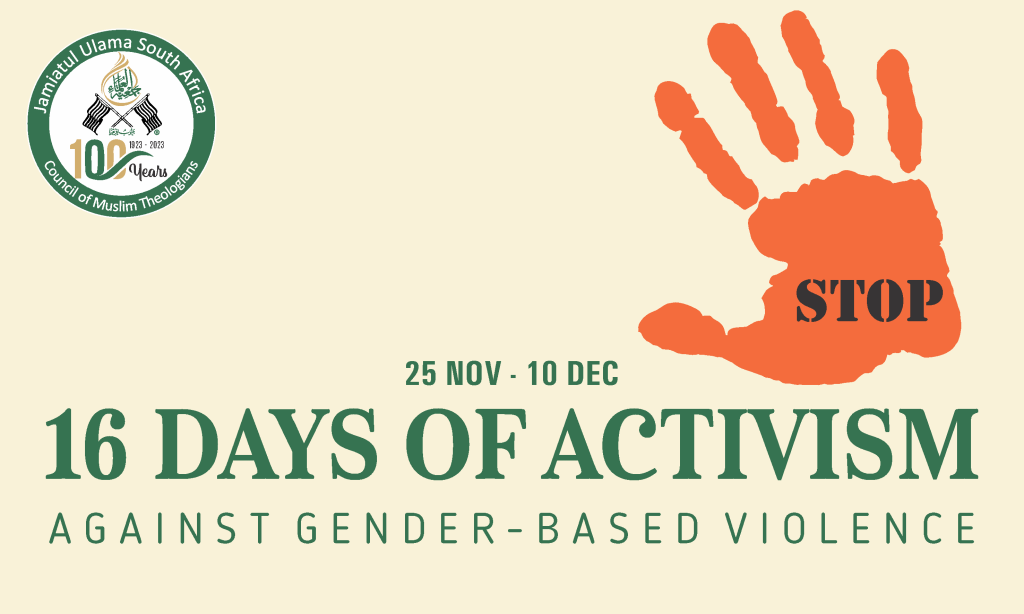
Officially, today is the first day of the annual 16 Days of Activism for No Violence against Women and Children. This year, the period has had an early start with a classification of Gender-Based Violence and Femicide (GBVF) as a National Disaster, after a declaration on Friday 21st November, when a nationwide protest against the crisis proportions of the scourge took place.
The Jamiatul Ulama South Africa (JUSA) joins the nation in this campaign, with an appeal to communities not to spare any efforts, and to embark on initiatives to end this bane, fraying the moral fibre of our society.
While we often cite statistics in order to highlight the scale of this blight on our society, it is important to remember, reflect and start to restore the ethical and moral foundations that have eroded from our shared values, giving rise to the monstrous violence that now claims at least 15 women, daily.
There are numerous traditions that underscore the importance as well as the obligatory nature, upon the community, of upholding and guarding children’s and women’s dignity and rights.
- The Prophet SAW led by example and predicated excellence of one’s conduct on the treatment of women when he said: “The best of you are those who are best to their women (wives)…” (Tirmidhī)
- Moreover, a maxim with far-reaching implications on faith has been passed on to us as a Prophetic Tradition and it reads: “None of you truly believes until he loves for his brother what he loves for himself.” (Bukharī)
- Specifically, in connection with the welfare of children, the Prophet SAW spelt out a rubric for disowning one from the Community of Believers when he said: “He who does not show mercy to our young and respect to our elders is not one of us.” (Tirmidhī)
- According to another Prophetic Tradition, care and protection of the girl child earns one eternal protection in the Hereafter. “Whoever has three daughters, is patient with them, feeds them, gives them drink, and clothes them from his wealth, they will be a shield for him from the Fire on the Day of Judgment.” (Ahmad)
It is also important to reflect upon, and mobilise against the many societal ills that exacerbate the scourge of GBVF. Substance abuse, economic inequality and harmful social norms, rank high among factors responsible for the perpetuation of GBVF.
Awareness of the impact of GBVF is necessary in order to mitigate its impact by— among other things— supporting and rehabilitating survivors, and also fostering change in attitudes towards such harms as alcoholism and other high risk behavioural factors behind the high incidence of cases of GBVF. It remains the state’s responsibility to ensure that justice is served, in order to increase deterrence to GBV, protect the vulnerable, and all citizens.
JUSA affirms the complementarity of gender roles as the basis for a more stable society where, women and men are partners and helpers of one another. Acknowledging the disproportionate levels of suffering of women and children, does not negate the reality that men also endure other forms of abuse in relationships. In any case, all efforts must be taken to end all manifestations of GBV, whether physical or emotional, and regardless of who the perpetrators are.
We turn to Allah to heal the hearts of all survivors of gender-based violence and other forms of abuse. We ask Him to help us honour and protect our mothers, sisters and daughters. O Allah! We seek Your Assistance in rectifying the conduct, and mending the ways of those that see no wrong in harming others. (Āmīn).
Released by:
The Executive Committee
Jamiatul Ulama South Africa
04 Jumaadal Aakhirah 1447 / 25 November 2025